TRIAGE2 · Sort the findings of the journeys and API contract rounds¶
Done 2026-10-27 · 61 findings: 21 accepted, 0 rejected, 40 sent to the inbox (33 assumed, 7 waiting for Thomas) · inbox #32–#40
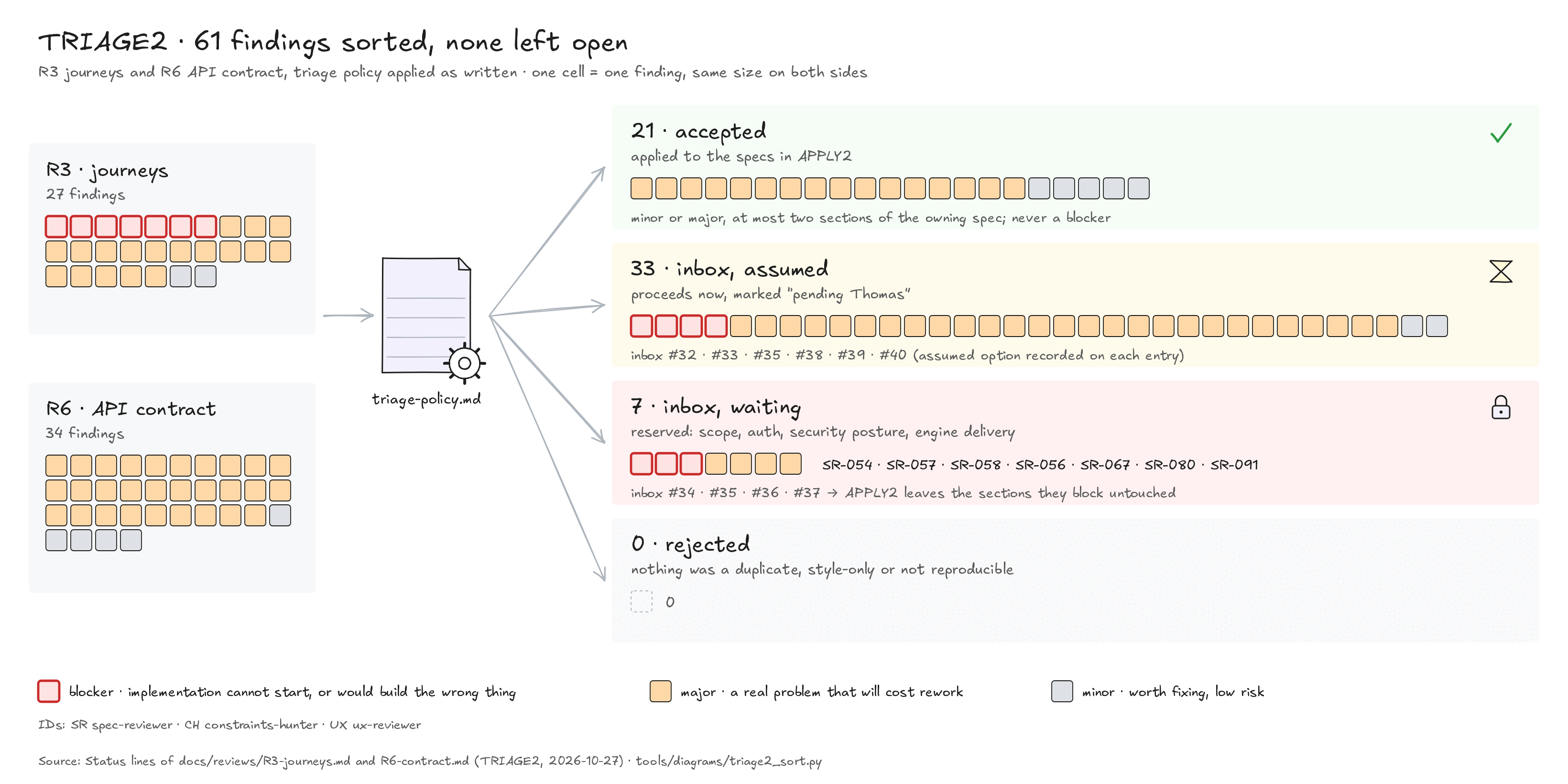
One cell is one finding, the same size on both sides. Red-edged cells are blockers, amber majors, grey minors. Four R3 blockers are assumed, three wait; none was accepted.
What changed¶
-
Status lines in two review files. Every finding's
Status: opennow holds a triage decision, dated(TRIAGE2, 2026-10-27), in the same four forms as TRIAGE1:accepted;rejected, with the reason (none this time);inbox, the question waits for Thomas;inbox, assumed: <option> — pending Thomas, the recommended option proceeds until Thomas answers.
The files are R3 (journeys) and R6 (0.0.1 API contract). Each header gets a one-line round summary, and each findings table gets a Status column (R6's "All findings" table had none, so the column is new there). - Inbox, entries #32 to #40. A new TRIAGE2 block groups the 40 inbox findings by decision. Each finding appears once, on a "Covers" line. Entries #1 to #31 are unchanged. - No spec was edited. Accepted and assumed findings reach the specs in APPLY2. - Commit on
autopilot/integration:autopilot(TRIAGE2): triage R3 and R6, 21 accepted, 40 inbox (33 assumed), entries #32–#40(the two review files,inbox.md, this page and the sorting figure with its script).
Why¶
Thomas should only see what needs him. The triage policy says what the autopilot may decide alone:
- accept a confirmed, local, minor or major fix that reverses no logged decision and stays out of the reserved topics;
- reject what cannot be reproduced, duplicates a handled finding, or only asks for style changes;
- send to the inbox everything else, and assume the recommended option when it is reversible and only affects docs.
R3 and R6 were written against the 0.0.1 cut, so the reserved topic that comes up most is the scope of 0.0.1 itself (dev-environment-and-testing.md §15.1): any answer that adds a feature to 0.0.1 or drops one goes to Thomas.
Step definition: TRIAGE2 in docs/playbooks/pipeline.yaml (wave W2, kind: triage, rounds R3 and R6, writes docs/reviews/*.md and docs/reviews/inbox.md). How triage fits into a tick: autopilot.md.
Evidence¶
How the step ran. The orchestrator triaged both rounds itself, as the autopilot skill asks for triage steps, with no subagent:
- "Confirmed" (policy condition 1): the R3 and R6 mergers had re-checked every finding against the quoted passages (Progress · R3, Progress · R6); both rounds were written on the same day, on the specs that are still current.
- "Local fix" (condition 3) was read strictly: at most two content sections in total, in the owning spec or specs. Other specs may only get a link or a one-line mirror (a CLI flag that mirrors an endpoint, a UI label). A new board frame, or a rule written into another spec, counts as content. A first pass had accepted 31 findings; re-checked this way, 10 of them change content in more than two sections, so they moved to the inbox as assumed, under the new entry #40: SR-061, CH-043, CH-046, CH-047, CH-048, CH-050, CH-051, SR-065 and UX-250 (R3), and SR-082 (R6). Their fix still proceeds in APPLY2; only the decision is left to Thomas.
- "No logged decision reversed" (condition 4): each accepted proposal was compared with the entries of
docs/decisions/log.mddated up to 2026-10-27, including the 0.0.1 cut. None reverses one. - Decisions were written into the files by one script. It asserted that every
### <ID>heading got exactly one decision, and that noStatus: openwas left. - The inbox "Covers" anchors were computed with the same slug rule as the site (Python-Markdown
toc), then checked bymkdocs build --strict.
Counts per round, read back from the review files. The columns are accepted, rejected, inbox (including assumed), assumed, and still open:
$ cd docs/reviews
$ for f in R3-journeys R6-contract; do printf "%-13s" $f; for s in accepted rejected inbox "inbox, assumed" open; do printf " %4s" "$(grep -c "Status:\*\* $s" $f.md)"; done; echo; done
R3-journeys      6    0   21   16    0
R6-contract     15    0   19   17    0
| Round | Findings | Accepted | Rejected | Inbox | of which assumed | waiting for Thomas |
|---|---|---|---|---|---|---|
| R3 | 27 | 6 | 0 | 21 | 16 | 5 |
| R6 | 34 | 15 | 0 | 19 | 17 | 2 |
| Total | 61 | 21 | 0 | 40 | 33 | 7 |
Severity against decision. This table joins each finding's heading with its status line (a short Python script over the two files):
| Severity | Accepted | Rejected | Inbox, waiting | Inbox, assumed | Total |
|---|---|---|---|---|---|
| blocker | 0 | 0 | 3 | 4 | 7 |
| major | 16 | 0 | 4 | 27 | 47 |
| minor | 5 | 0 | 0 | 2 | 7 |
| Total | 21 | 0 | 7 | 33 | 61 |
All seven blockers are in R3. No blocker was accepted, because the policy accepts only minors and majors (fact corrections excepted):
- assumed (4): SR-062 and CH-042 (relaunch and resume, #32), SR-055 and CH-041 (local runner and detached heads, #35);
- waiting for Thomas (3): SR-057 and SR-058 (how rnaseq gets a gate, MultiQC in the install, #34) and SR-054 (ingest contract, #36).
The four majors that wait are SR-056 (#34), SR-067 (#35), SR-080 (#36) and SR-091 (#37).
Exit criterion. TRIAGE2 has no exit_check of its own in pipeline.yaml; the wave W2 check is python3 tools/docs/check.py. The step's own outputs are complete: no finding is left open (last column above), and inbox.md holds entries #32 to #40.
Figures and media¶
- Sorting figure at the top of this page (to-scale, one cell per finding), as
documentation-system.md§3.1 asks for atriagestep. Script:tools/diagrams/triage2_sort.py; outputsdocs/assets/diagrams/triage2_sort_{light,dark}.{svg,png}.
Findings and open questions¶
Inbox entries from this step. In short (the full wording is in the inbox):
| # | Topic | Findings | Assumed already | Blocks APPLY2 |
|---|---|---|---|---|
| 32 | relaunch at a gate, resume after a failure, 0.0.1 gate verbs | 10 (2 blockers) | all 10, option (B): a child run | no |
| 33 | default when every check passes | 1 | (c): opt-in auto-approve, waits by default | no |
| 34 | how rnaseq gets stages and a gate; MultiQC in the install | 3 (2 blockers) | none (scope is reserved) | yes |
| 35 | local runner record, detached heads, who installs the engines | 3 (2 blockers) | SR-055, CH-041 | the prerequisites section only |
| 36 | ingest contract for 0.0.1, split of #11 | 2 (1 blocker) | none (auth is reserved) | yes |
| 37 | browser protection for the token-less loopback API | 1 | none (security posture is reserved) | yes |
| 38 | assumed: engine events, progress denominator | 3 | all 3 | no |
| 39 | assumed: the reads 0.0.1 boards need | 7 | all 7 | no |
| 40 | assumed: fixes that are right but not local | 10 | all 10, (a): apply as written | no |
- #32 has the most weight. It holds both R3 relaunch blockers and five R6 findings about ReviewReport's action bar. The assumed option (B) keeps the run states as they are and makes "Relaunch…" and "Resume" create a child run;
applyandgo_backare not in 0.0.1. - #34 and #36 decide whether journey 1 works end to end. Without an answer, APPLY2 cannot say how rnaseq gets its gate or how the bridges report a driven run.
- #36 overlaps #11. It asks to split #11 so that the driven-run part of api §14 can be written for 0.0.1, while the observed-run credential stays deferred.
Next. APPLY2 applies the 21 accepted and 33 assumed findings of R3 and R6, and leaves untouched the sections named on the "Blocked" lines of #34, #35 (SR-067 part), #36 and #37.